Credit Card EMI in India
Overview
Credit card EMI — equated monthly instalment — splits a credit card purchase or outstanding balance into fixed monthly payments over a set tenure, typically 3 to 24 months. The bank charges interest (quoted as a flat annual rate, usually 12–18% for major issuers), a one-time processing fee (₹199–₹999 or 1–3% of the transaction amount), and 18% GST on both the interest and the fee. The result: a “14% EMI” on a ₹1 lakh purchase does not cost ₹14,000 in extra charges — it costs closer to ₹18,300 when all components are included.
India’s credit card market crossed 100 million active cards during 2024, per RBI payment systems data. As card penetration grows, EMI conversion has become the default instalment mechanism for large purchases — smartphones and laptops on Amazon and Flipkart, medical bills, wedding expenses, and home appliances. Banks actively push EMI as a revenue tool: HDFC Bank, SBI Card, ICICI Bank, and Axis Bank all offer one-tap EMI conversion through their mobile apps.
The critical distinction most cardholders miss is between the flat interest rate banks quote and the effective annual rate they actually pay. A 14% flat rate on a 12-month EMI translates to roughly 25% effective annual rate, because interest is calculated on the full principal for the entire tenure — not on the declining balance. This makes credit card EMI significantly more expensive than a personal loan at a comparable quoted rate. For a detailed comparison, see CardTrail’s guide on credit card EMI vs personal loan.
No-cost EMI — the most aggressively marketed variant — is not truly free either. The interest is absorbed by the merchant as a product discount, but the 18% GST on that hidden interest is still charged to the cardholder. On a ₹60,000 purchase, this GST alone can add ₹450–₹2,500 depending on tenure — a cost that most “no-cost EMI” screens never surface.
The RBI Master Direction on Credit Card and Debit Card — Issuance and Conduct Directions, 2022 mandates that banks disclose the total cost of EMI conversion — including effective annual rate, all fees, and GST — before the cardholder confirms. Starting July 2026, weekly credit bureau reporting means a missed EMI payment will affect a cardholder’s CIBIL score within days, not weeks.
Key Facts Every Cardholder Should Know
-
Banks quote flat rates, not effective rates. A “14% per annum” credit card EMI actually costs ~25% on a reducing-balance basis — nearly double the quoted figure. The RBI requires banks to disclose the effective APR, but most EMI conversion screens show only the flat rate prominently. (Source: RBI Master Direction 2022, Section 11)
-
18% GST applies on both interest and processing fees. This is the cost most cardholders overlook entirely. On a ₹1 lakh, 12-month EMI at 14% flat with a 1.5% processing fee, the total GST component alone exceeds ₹2,790. (Source: CGST Act, 2017 — financial services taxed at 18%)
-
No-cost EMI still carries a GST charge. The merchant absorbs the interest via a product discount, but the 18% GST on that interest is passed to the cardholder. “No cost” means no interest to the customer — not zero extra charges.
-
EMI conversion blocks the full outstanding amount, not just the monthly instalment. A ₹60,000 EMI on a ₹2 lakh limit card drops available credit to ₹1,40,000. The limit recovers gradually as each EMI is repaid. Credit utilisation above 30% drags down a cardholder’s CIBIL score.
-
Most banks do not award reward points on EMI transactions. Converting a purchase to EMI typically forfeits the reward points that transaction would have earned. On a card earning 3.3% rewards, a ₹60,000 EMI means forgoing ₹1,980 in rewards — an effective hidden cost on top of stated charges.
-
Weekly credit bureau reporting starts July 2026. RBI has directed banks to update credit data with bureaus weekly instead of monthly. A missed EMI will reflect on a credit report within days, making timely payment non-negotiable. (Source: RBI Master Direction 2022, updated provisions)
-
Foreclosure of credit card EMI cannot attract a penalty. RBI mandates that cardholders can pre-close any credit card EMI without the bank charging a foreclosure fee. If charged, file a complaint on the RBI CMS portal. (Source: RBI Master Direction 2022)
Best Cards for EMI in India
For EMI conversions, the issuing bank matters more than the specific card — EMI interest rates are determined primarily by the bank’s policies, the cardholder’s credit profile, and the duration of the banking relationship. However, certain cards offer features that make EMI usage more practical: low annual fees reduce total cost of ownership, achievable fee waivers prevent paying annual charges on top of EMI interest, and cards from banks with competitive EMI rates deliver lower overall costs. HDFC Bank typically offers 12–15% flat rates and Axis Bank 12–16% flat — among the lowest across major issuers.
From CardTrail’s database, the following cards are well-suited for cardholders who frequently use EMI:
| Card | Annual Fee | Fee Waiver | Bank | Reward Rate | Min Income | EMI Suitability |
|---|---|---|---|---|---|---|
| HDFC Swiggy Credit Card | ₹500 | Spend ₹2L/year | HDFC | 1.0% (max 10.0%) | ₹2,00,000 | Most accessible HDFC card |
| Flipkart Axis Bank Super Elite | ₹500 | Spend ₹2L/year | Axis | 2.0% (max 16.0%) | ₹3,00,000 | E-commerce EMI on Flipkart |
| Airtel Axis Bank Credit Card | ₹500 | Spend ₹2L/year | Axis | 1.0% (max 25.0%) | ₹4,00,000 | Cashback offsets EMI costs |
| American Express SmartEarn | ₹495 | Spend ₹40K/year | Amex | 0.5% (max 10.0%) | ₹3,00,000 | Lowest fee waiver threshold |
| HDFC Diners Club Privilege | ₹1,000 | Spend ₹3L/year | HDFC | 1.3% (max 10.0%) | ₹6,00,000 | Premium HDFC EMI rates |
| HDFC Tata Neu Infinity | ₹1,499 | Spend ₹3L/year | HDFC | 1.5% (max 10.0%) | ₹3,00,000 | Tata ecosystem EMI purchases |
| HDFC Regalia | ₹2,500 | Spend ₹3L/year | HDFC | 1.3% (max 13.0%) | ₹12,00,000 | Preferred EMI rates for high earners |
CardTrail’s analysis: HDFC Bank cards dominate this list because HDFC offers the widest EMI tenure range (3–24 months) and among the lowest flat rates in the industry (12–15%). The HDFC Swiggy Credit Card is the most accessible entry point with a ₹2,00,000 minimum income requirement — the lowest among HDFC cards here — and a ₹500 annual fee waivable at ₹2 lakh annual spend. For e-commerce EMI, especially during Flipkart Big Billion Days, the Flipkart Axis Bank Super Elite earns 2.0% base rewards in SuperCoins — the highest base reward rate in this comparison. HDFC also offers a dedicated HDFC Easy EMI Credit Card designed specifically for instalment purchases, worth considering if EMI conversion is the primary use case.
How It Works in India
The EMI Conversion Process
Credit card EMI conversion in India works through two routes:
Post-purchase conversion (most common):
- Make a purchase on the credit card. Minimum transaction amount for EMI eligibility is typically ₹2,500–₹5,000, depending on the bank.
- Wait for the transaction to post (not pending) — usually 2–3 working days.
- Open the bank’s mobile app or call the credit card helpline.
- Select the transaction and choose “Convert to EMI.”
- Pick a tenure (3, 6, 9, 12, 18, or 24 months). The app displays the interest rate, processing fee, and total cost.
- Confirm. The full purchase amount is blocked from the available credit limit. The first EMI appears in the next billing cycle.
Pre-approved EMI at checkout: E-commerce platforms like Amazon, Flipkart, and Croma display EMI options during payment. The bank pre-approves the card for EMI based on available limit and credit profile. Select the plan, review the cost breakup, and confirm — no post-purchase steps needed.
Three Types of Credit Card EMI
-
Regular EMI — The bank charges full interest (12–18% p.a. flat for major banks) plus a processing fee. The most transparent option; also the most expensive.
-
No-cost EMI — The merchant absorbs interest by offering a discount equal to the interest amount. The cardholder still pays 18% GST on the hidden interest and usually a processing fee. For the full breakdown, see CardTrail’s guide on the no-cost EMI trap.
-
Low-cost EMI — A reduced interest rate from bank-merchant tie-ups. Cheaper than regular EMI, but the discount is partial — not zero-cost.
RBI Regulations Governing Credit Card EMI
The RBI Master Direction on Credit Cards, 2022 sets binding rules for all EMI issuers:
- Cost disclosure: Banks must display the total cost — effective APR, processing fees, GST, and total outgo — before the cardholder confirms conversion. Non-disclosure is a regulatory violation.
- Foreclosure rights: Cardholders can pre-close any credit card EMI at any time without penalty charges.
- E-mandate protection: Recurring EMI debits above ₹15,000 require explicit cardholder consent under the 2021 e-mandate framework, with a pre-debit notification at least 24 hours in advance.
- Weekly bureau reporting (July 2026): Banks must update credit data to CIBIL and other bureaus weekly — a missed EMI impacts the score within days, not weeks.
For the complete regulatory breakdown, see CardTrail’s RBI rules guide for credit card EMI.
Common Mistakes to Avoid
-
Treating the flat rate as the real cost. A “14% per annum” EMI sounds reasonable until the effective rate turns out to be ~25%. The flat rate method charges interest on the original principal throughout the tenure, not on the declining balance. Always ask for or calculate the effective APR before converting.
-
Ignoring GST on no-cost EMI. “No cost” means the merchant covers interest — not that there is zero additional charge. The 18% GST on the interest component is still billed to the cardholder. On a ₹1,00,000 purchase at 14% for 12 months, this GST alone is ₹2,520.
-
Stacking multiple EMIs without tracking utilisation. Each active EMI blocks its full outstanding against the credit limit. Three simultaneous EMIs of ₹50,000 each on a ₹3 lakh limit push utilisation to 50% — well above the 30% threshold that credit bureaus consider healthy.
-
Choosing longer tenures to reduce monthly payments. A 24-month EMI at 14% flat on ₹1 lakh costs ₹28,000 in interest alone. The same amount over 6 months costs ₹7,000. The monthly payment is higher on the shorter tenure, but the total saving is ₹21,000 — a difference that gets obscured when the focus is on “affordable monthly payments.”
-
Not comparing with a personal loan. For amounts above ₹50,000 and tenures beyond 6 months, a personal loan at 10.5–14% reducing balance is nearly always cheaper than credit card EMI at 12–16% flat. The 24–72 hour approval delay is a small trade-off for thousands in savings.
-
Using EMI for discretionary purchases. EMI makes expensive items feel affordable by splitting them into small monthly chunks. A ₹80,000 phone at ₹6,667/month still costs ₹80,000 — plus interest, fees, and GST. If a purchase requires EMI to feel affordable, it is likely outside the budget.
Comparison Table
Detailed Feature Comparison: Cards Suited for EMI
| Card | Annual Fee | Joining Fee | Fee Waiver | Reward Currency | Welcome Bonus | Forex Markup |
|---|---|---|---|---|---|---|
| HDFC Swiggy Credit Card | ₹500 | ₹500 | Spend ₹2L/year | Cashback (Swiggy Money) | ₹500 Swiggy voucher | 3.5% |
| Flipkart Axis Bank Super Elite | ₹500 | ₹500 | Spend ₹2L/year | SuperCoins | 500 SuperCoins + up to ₹20,000 rewards | 3.5% |
| Airtel Axis Bank Credit Card | ₹500 | ₹500 | Spend ₹2L/year | Cashback | ₹500 Amazon voucher | 3.5% |
| American Express SmartEarn | ₹495 | ₹495 | Spend ₹40K/year | Membership Rewards Points | ₹500 cashback on ₹10K spend in 90 days | 3.5% |
| HDFC Diners Club Privilege | ₹1,000 | ₹1,000 | Spend ₹3L/year | Reward Points | 5,000 Reward Points | 3.5% |
| HDFC Tata Neu Infinity | ₹1,499 | ₹1,499 | Spend ₹3L/year | NeuCoins (1 NeuCoin = ₹1) | 1,500 NeuCoins | 3.5% |
| HDFC Regalia | ₹2,500 | ₹2,500 | Spend ₹3L/year | Regalia Reward Points | 2,500 Reward Points | 3.5% |
CardTrail’s True Cost Analysis: What a ₹1 Lakh EMI Actually Costs
Most EMI conversion screens show the monthly instalment and stop there. CardTrail calculated the complete outgo for a ₹1,00,000 purchase — including principal, interest at 14% flat rate, a 1.5% processing fee, and 18% GST on both interest and fee — across all standard tenures.
Step-by-step calculation (12-month tenure example):
- Interest: ₹1,00,000 × 14% × (12/12) = ₹14,000
- Processing fee: ₹1,00,000 × 1.5% = ₹1,500
- GST on interest: ₹14,000 × 18% = ₹2,520
- GST on processing fee: ₹1,500 × 18% = ₹270
- Total: ₹1,00,000 + ₹14,000 + ₹1,500 + ₹2,520 + ₹270 = ₹1,18,290
| Tenure | Monthly EMI | Total Interest | All Fees & GST | Total You Pay |
|---|---|---|---|---|
| 3 months | ₹34,500 | ₹3,500 | ₹2,400 | ₹1,05,900 |
| 6 months | ₹17,833 | ₹7,000 | ₹3,030 | ₹1,10,030 |
| 9 months | ₹12,278 | ₹10,500 | ₹3,660 | ₹1,14,160 |
| 12 months | ₹9,500 | ₹14,000 | ₹4,290 | ₹1,18,290 |
| 18 months | ₹6,722 | ₹21,000 | ₹5,550 | ₹1,26,550 |
| 24 months | ₹5,333 | ₹28,000 | ₹6,810 | ₹1,34,810 |
Assumptions: ₹1,00,000 principal, 14% p.a. flat rate, 1.5% processing fee, 18% GST on interest and processing fee. Actual rates vary by bank, card variant, and credit profile.
The gap between the 3-month and 24-month tenure is ₹28,910 — nearly 29% of the purchase price. Every additional month of tenure adds roughly ₹1,380 in total cost. For anyone with the monthly cash flow to absorb it, choosing the shortest feasible tenure is the single most effective way to reduce EMI cost. Use CardTrail’s EMI vs cash calculator to model a specific scenario.
Related Tools
CardTrail’s EMI Calculator computes the true cost of any credit card EMI — not just the monthly instalment, but the complete outgo including processing fees, GST on interest, and GST on the processing fee. Enter the purchase amount, select a tenure, and input the bank’s quoted flat rate to see the total cost, effective APR, and a month-by-month amortisation breakdown.
The calculator is particularly useful for comparing no-cost EMI against paying upfront — it surfaces the GST component that most bank apps hide. For a worked example and methodology, see CardTrail’s credit card EMI calculator guide.
Frequently Asked Questions
How does a credit card EMI calculator work?
A credit card EMI calculator uses the standard instalment formula: EMI = P × r × (1 + r)^n / ((1 + r)^n – 1), where P is the principal amount, r is the monthly interest rate (annual rate ÷ 12), and n is the tenure in months. For credit card EMI specifically, the calculator must also factor in the processing fee (typically 1–3% of the transaction), 18% GST on both the interest and the processing fee, and the distinction between the bank’s quoted flat rate and the effective reducing-balance rate. CardTrail’s EMI Calculator handles all three components and displays the total outgo — not just the monthly figure. Bank-specific calculators (like HDFC’s in-app tool) typically show only the flat rate and monthly EMI, often omitting the effective APR and GST breakup.
What interest rate do banks charge for credit card EMI in India?
Major Indian banks charge 12–18% per annum flat rate for credit card EMI conversions. HDFC Bank typically offers 12–15% flat, ICICI Bank 12–15%, Axis Bank 12–16%, SBI Card 13–16%, and Kotak Mahindra 13–16%. Premium cards like the HDFC Infinia (annual fee: ₹12,500) and HDFC Regalia (annual fee: ₹2,500) often receive preferential rates at the lower end of the range. The crucial caveat: these are flat rates, not reducing-balance rates. A 14% flat rate translates to roughly 25% effective annual rate — nearly double the headline number. The actual rate offered depends on the card variant, credit score, and tenure selected. (Source: Bank-specific EMI terms — HDFC Bank, ICICI Bank, SBI Card, Axis Bank card T&Cs)
How is GST calculated on credit card EMI?
GST at 18% applies on two components of credit card EMI: the interest charged and the processing fee. Here is a step-by-step example for a ₹60,000 purchase at 14% flat for 12 months with a ₹999 processing fee:
- Interest: ₹60,000 × 14% × 1 year = ₹8,400
- GST on interest: ₹8,400 × 18% = ₹1,512
- Processing fee: ₹999
- GST on processing fee: ₹999 × 18% = ₹180
- Total GST paid: ₹1,692
On no-cost EMI, the interest is waived (absorbed by the merchant), but the GST on that interest amount is still charged to the cardholder — making “no cost” a misnomer. (Source: CGST Act, 2017 — Schedule III, Financial Services)
Which is the best credit card for EMI in India?
The best EMI credit card depends on the issuing bank more than the card itself, since EMI rates are set at bank level. Among accessible options, the HDFC Swiggy Credit Card (annual fee: ₹500, fee waiver at ₹2L spend) provides access to HDFC Bank’s competitive 12–15% flat EMI rates at a minimum income of just ₹2,00,000. For e-commerce EMI on Flipkart, the Flipkart Axis Bank Super Elite (annual fee: ₹500) delivers 2.0% base rewards in SuperCoins — the highest in its fee bracket. For cardholders whose primary use case is instalment purchases, HDFC also offers a dedicated HDFC Easy EMI Credit Card built specifically for EMI conversion.
Is no-cost EMI on credit cards really free?
Not entirely. “No-cost EMI” means the merchant absorbs the interest by providing a discount equal to the interest amount — so the interest and discount cancel out, and the cardholder pays the listed MRP split across months. However, three charges remain: (a) 18% GST on the hidden interest — on a ₹1 lakh purchase at 14% for 12 months, this is ₹2,520; (b) a processing fee of ₹199–₹499 at most banks, plus 18% GST on that fee; and (c) potentially a lost cash discount — some merchants offer a separate debit card or UPI discount that vanishes when EMI is selected. For the full breakdown, see CardTrail’s no-cost EMI guide.
Does credit card EMI conversion affect my CIBIL score?
Converting a purchase to EMI does not directly hurt the score, but it increases the credit utilisation ratio — the percentage of total credit limit currently in use. A ₹1 lakh EMI blocking most of a ₹1.5 lakh limit pushes utilisation to 67%, well above the 30% threshold CIBIL considers healthy. With the RBI mandating weekly credit bureau reporting from July 2026, elevated utilisation will reflect within days. Missed EMI payments carry a steeper consequence: the overdue amount moves to revolving credit at 36–42% APR (the standard credit card revolving rate in India), a late payment fee of ₹500–₹1,300 is levied, and the delinquency is reported to all four credit bureaus. (Source: RBI Master Direction 2022)
Cards Worth Considering
Based on this article's topic. Scores reflect real value, not sponsorships.
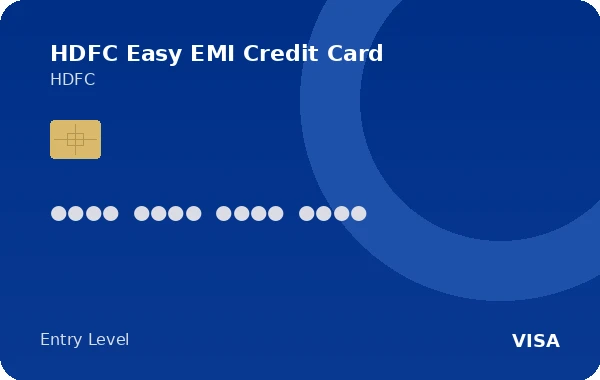
HDFC Easy EMI Credit Card
HDFC · ₹500/yr
Annual fee ₹500 (waiver: Spend ₹50K/year)

Bajaj Finserv RBL Bank SuperCard
RBL · ₹999/yr
Interest-free emergency loan for 90 days (up to 3 months/year)

IDBI Imperium Platinum Credit Card
IDBI · ₹499/yr
Secured card — credit limit up to 85% of Fixed Deposit
Found this useful?
Get notified when card rules change, benefits get devalued, or new cards launch. One email, only when it matters.
Explore more guides